
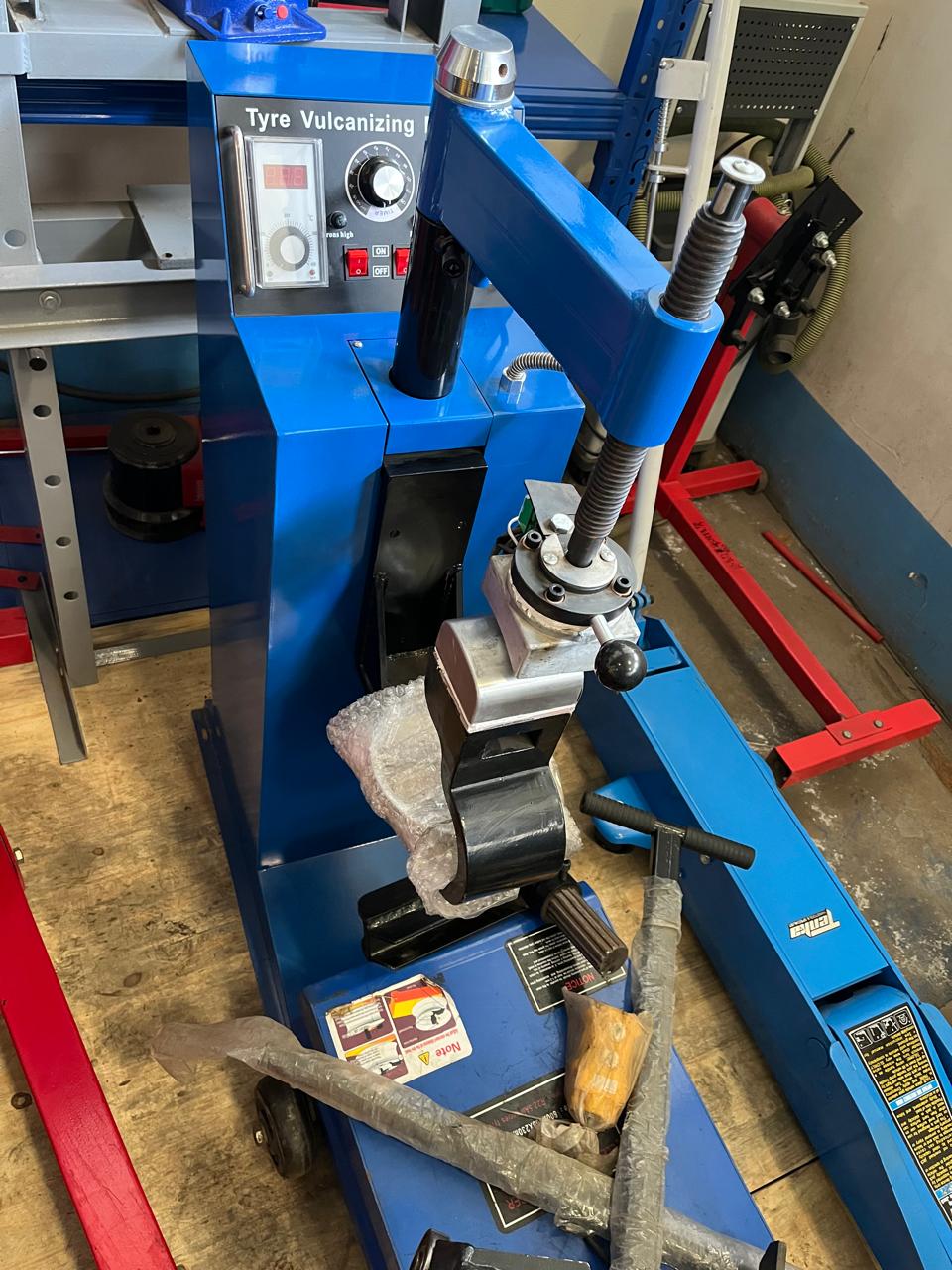
Description
A specialized heated press that performs permanent, chemical-bonded repairs on tire inner liners, primarily for truck, bus, and heavy equipment tires. It’s the industry standard for a “cold patch” repair.
How It Works
It uses controlled heat, pressure, and time to cure a raw rubber repair patch. The process chemically vulcanizes (fuses) the patch material to the tire’s inner liner, creating a permanent, air-tight seal that becomes part of the tire structure.
The Standard 4-Step Process:
Inspect & Prepare: The injury is located, marked, and the inner liner is buffed to clean, fresh rubber.
Apply Cement & Patch: Special rubber cement and a raw, uncured repair patch (with a stem plug for punctures) are applied.
Vulcanize: The prepared area is placed in the machine’s heated press. Pressure is applied for a set time (e.g., 20-40 mins at 280°F/140°C).
Cool & Finish: The repair is allowed to cool under pressure, then trimmed and inspected.
Key Components
Heated Platens: Top and bottom heated plates that apply even heat and pressure.
Hydraulic or Manual Press: To apply consistent clamping force.
Temperature & Timer Controls: For precise curing cycles.
Mold Inserts/Bladders: To conform pressure to the tire’s inner curvature.
Primary Purpose
To execute a TIA/Industry-Standard, RMA-approved radial tire repair (e.g., for injuries up to 3/8″ / 10mm). This is the only repair method considered permanent and reliable for commercial service.
Critical Rules for Use
Repair Limits: Can only repair injuries within the crown area of the tire (center 2/3 of tread width), not in the shoulder or sidewall. Must follow industry repair size limits.
Proper Inspection is Mandatory: The tire must be fully demounted and internally inspected for hidden damage (separations, broken belts) that would make it unrepairable.
Exact Preparation: The buffing area must be clean, uniform, and slightly larger than the patch. Any contamination (dirt, oil, old cement) will cause bond failure.
Follow the Cure Cycle Precisely: Time, temperature, and pressure must be exact per the patch manufacturer’s specs. Under-curing weakens the bond; over-curing degrades the rubber.
Use Compatible Materials: The patch, cement, and filler must be from the same manufacturer/system and be fresh (not expired).
Safety: The machine gets extremely hot. Use heat-resistant gloves and keep the area clear. Ensure electrical connections are safe for the high current draw.
Bottom Line
A vulcanizing machine is the essential professional equipment for performing permanent, warrantied repairs on commercial truck and OTR tires. It is not for temporary plugs or passenger car tires (which often use simpler “cold” patches). Its use defines a professional tire service shop, as the quality of the repair is only as good as the technician’s skill in inspection, preparation, and precise operation of the machine.

Reviews
There are no reviews yet.