
Description
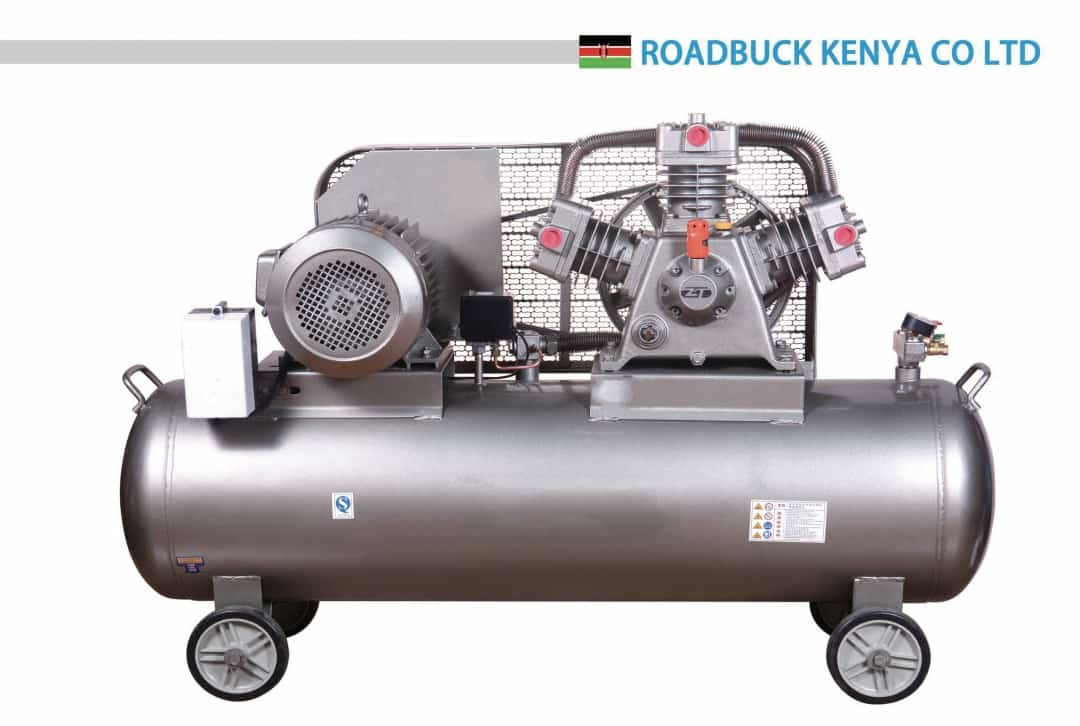
A heavy-duty, industrial belt-drive reciprocating air compressor.
200L: Features a large 200-litre (≈53 US gallon) air storage tank.
8: Delivers approximately 8 cubic feet per minute (CFM) of compressed air.
B: Belt-driven system connecting the motor to the pump.
How It Works
A powerful electric motor drives a crankshaft via V-belts. This crankshaft operates dual pistons inside cast-iron cylinders, drawing in and compressing air, which is then stored in the large vertical or horizontal tank. A pressure switch automatically cycles the motor to maintain a preset pressure range (e.g., 8-10 bar / 115-145 PSI).
Key Components & Specs
Pump: Heavy-duty, cast iron, oil-lubricated, designed for continuous operation.
Motor: Typically a robust 4 HP (3 kW) induction motor capable of handling the startup load. Common configurations are single-phase 230V (for smaller shops) or three-phase 400V (for industrial settings).
Output: ~8 CFM at working pressure (e.g., 90 PSI/6.2 bar). This is the air delivery rate.
Tank Pressure: Maximum operating pressure is usually 145 PSI (10 bar).
Duty Cycle: Designed for 100% duty cycle in professional workshop environments, meaning it can run continuously within its thermal limits.
Primary Workshop Applications
Sustained Operation of One Tool: Can reliably run a ½” impact wrench, air ratchet, die grinder, or spray gun for extended periods with good recovery time.
Small to Medium Auto & Repair Shops: Ideal for general mechanical work, tire servicing, and light bodywork where air demand is intermittent but regular.
Industrial & Woodworking Shops: Powering multiple clamps, nailers, or small machinery sequentially.
Garage & Serious DIY: A substantial compressor for home workshops with high air needs.
Critical Advantages
Large Air Reserve: The 200L tank provides a significant buffer of stored air. This allows the compressor to meet short, high-demand bursts without the motor needing to cycle on immediately, reducing wear and allowing tools to run longer between pump cycles.
Belt-Drive Reliability & Efficiency: Runs cooler and quieter than direct-drive models. The belts act as a shock absorber, reducing strain on the motor and pump bearings, leading to longer service life.
Industrial Durability: The cast-iron pump is built for long-term, daily use in a professional setting.
Critical Safety & Operational Rules
Proper Electrical Supply: This unit has a high starting current. Ensure wiring, circuit breakers, and outlets are rated for the motor’s full-load and locked-rotor amperage. A dedicated circuit is mandatory.
Foundation & Placement: Must be placed on a solid, level, and vibration-dampening surface (concrete pad). Secure it if necessary. Ensure ample clearance for cooling air intake and ventilation around the pump and motor.
Daily Tank Drainage: Condensate is the #1 enemy. You MUST open the tank drain valve at the bottom every single day after use to eject accumulated water. Failure leads to internal rust, tank failure, and contaminated air lines.
Regular Oil Checks & Changes: Monitor the oil level via the sight glass weekly. Change the compressor oil according to the manual (typically every 500-1000 hours of operation). Use only the recommended non-detergent compressor oil.
Install an Air Treatment Set (FRL): After the compressor outlet, use a Filter (removes water/oil), Regulator (sets tool pressure), and Lubricator (oils air tools) to protect your equipment and ensure quality air.
Inspect Belts & Safety Valve: Periodically check belt tension and condition. Never tamper with the pressure relief valve—it is a critical fail-safe. Test its function occasionally by manually lifting the lever.
Allow for Cool Down: After extended use, let the compressor cool before performing maintenance or transporting it.
Bottom Line
The 200L-8B belt-drive compressor is a professional-grade workhorse that prioritizes air reserve and durability. Its large tank makes it exceptionally practical for shops with intermittent but demanding air tool use. While its CFM output is moderate, the tank size compensates effectively. Its longevity is entirely dependent on rigorous daily draining, proper oil maintenance, and a correct electrical installation. It’s a foundational investment for a serious workshop.



Reviews
There are no reviews yet.