
Description
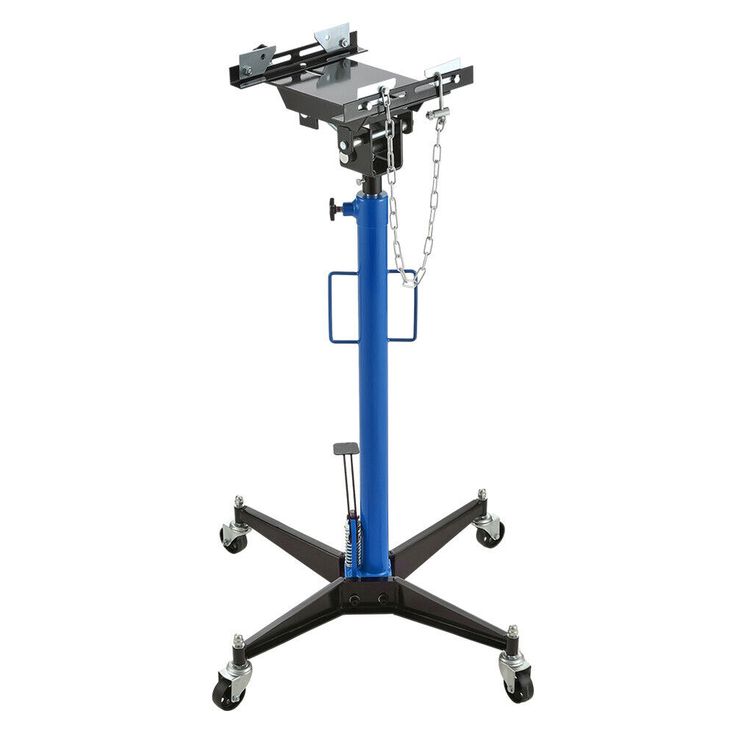
A specialized hydraulic lifting table designed to safely support, lower, and raise a vehicle’s transmission, transfer case, or differential during removal and installation.
How It Works
A low-profile platform with adjustable arms is positioned under the component. A hydraulic pump (hand, foot, or air-over-hydraulic) raises the platform. The jack is mounted on casters, allowing the heavy assembly to be rolled out from under the vehicle with precision and stability.
Key Features
Low Profile & Extendable: Fits under lowered vehicles; arms often telescope to fit different sizes.
Adjustable Arms/Straps: Adaptable to secure transmissions, differentials, or large axle assemblies.
Tilt & Rotation: Most have a tilting platform or cradle to angle the component for alignment with the engine block.
Safety Chain/Locking Mechanism: A chain or lock secures the transmission to the jack.
Capacity: Typically ranges from 500 to 1500+ lbs, matching the weight of heavy-duty units.
Primary Purpose
To provide secure, stable, and controlled handling of heavy, bulky, and awkward drivetrain components. Prevents damage to the component, vehicle, and most importantly, prevents crush injuries to the technician.
Critical Safety & Operating Rules
Secure the Load: Always use the adjustable arms, cradle, or safety straps to positively lock the transmission to the jack before lifting. The center of gravity is often high and unstable.
Use the Safety Chain: After securing the component, attach the provided safety chain as a secondary fail-safe.
Check Clearance: Ensure the jack’s height and the component’s tilt are adjusted to clear all obstacles (exhaust, crossmembers, floor) during removal.
Tilt for Alignment: When installing, use the tilt function to precisely match the transmission’s angle to the engine block for smooth engagement of the input shaft.
Jack Stands for the Vehicle: The vehicle must be securely supported on jack stands at a safe working height. Do not rely on a vehicle lift or jack alone.
Inspect Hydraulics: Check for leaks and ensure the release valve operates smoothly before loading.
Bottom Line
A transmission jack is a critical safety and efficiency tool for any shop performing drivetrain work. It turns a dangerous, multi-person struggle with a heavy, greasy component into a safe, controlled, one-person operation. Never attempt to remove or install a transmission by hand—even a small transmission can cause severe injury. Proper use prevents damage and ensures a precise, safe installation.
Reviews
There are no reviews yet.