
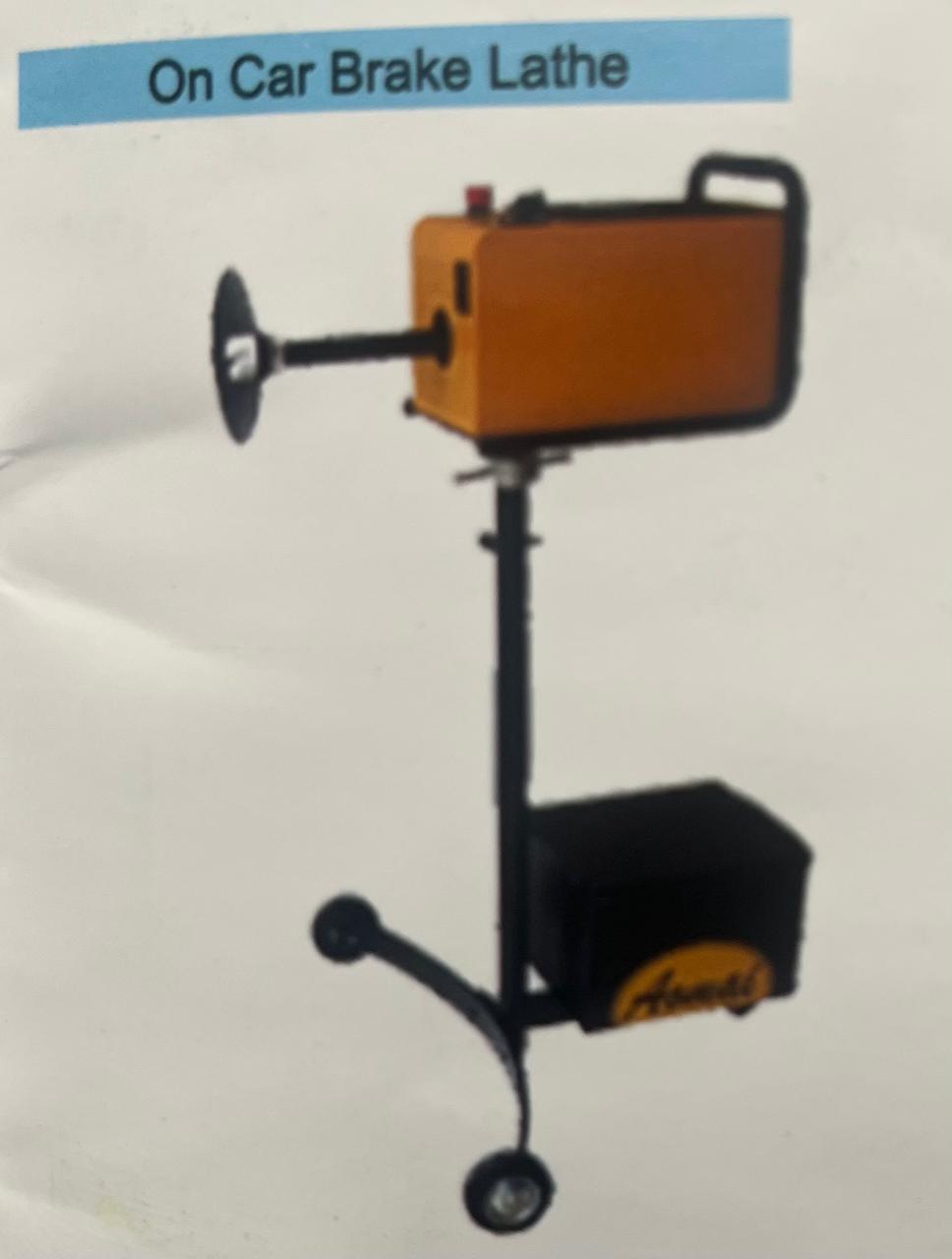
Description
A specialized machine that machines (turns/cuts) a vehicle’s brake rotors and drums while they are still mounted on the vehicle’s hub. It corrects issues like thickness variation (DTV), runout, and surface imperfections without removing the brake rotor.
How It Works
The machine attaches directly to the vehicle’s hub or steering knuckle, using it as a reference point. A cutting tool is then precisely positioned and driven across the face of the spinning rotor (or inside a drum), removing a thin layer of material to create a fresh, flat, and parallel friction surface.
Key Components
Adaptors & Arbors: Securely mount the lathe to the vehicle’s specific hub or stud pattern.
Motor Drive Unit: Spins the rotor via the lug nuts or a direct-drive attachment.
Cross-Feed & Cutting Tool: The precision mechanism that moves the cutting bit across the rotor surface.
Drum Attachment: Special setup for machining the inner surface of brake drums.
Primary Purpose & Advantage
To correct lateral runout and disc thickness variation (DTV) caused by hub/stack-up issues. Because it machines the rotor in the exact same position it operates in, it creates a perfectly true mating surface relative to the hub, eliminating the “wobble” that can persist even with a perfectly machined rotor installed on a slightly imperfect hub.
When It’s Used (Ideal Scenarios)
Correcting brake pedal pulsation or steering wheel shudder during braking.
When a rotor has minor scoring or surface rust but sufficient minimum thickness.
As a precision service on high-end vehicles or performance applications.
When hub/assembly runout is suspected as the root cause of vibration.
Critical Safety & Operational Rules
Secure Vehicle & Safety First: Vehicle must be on a level lift, with the wheel removed and the area clear. Use appropriate wheel chocks and lift locks.
Clean & Inspect Hub: The mounting hub surface must be meticulously cleaned of all rust, dirt, and debris. Any residue will transfer inaccuracy to the cut.
Correct & Tight Mounting: The lathe must be mounted squarely and torqued securely to the hub. A loose mount ruins the cut and damages the tool.
Measure Before Cutting: Always use a micrometer to confirm the rotor has enough material left above the minimum discard thickness to be safely machined.
Use Proper Cutter Bits & Speeds: Follow manufacturer specs for feed rate and cutter type. A dull bit will leave a poor finish and cause chatter.
Final Cleaning is Mandatory: After machining, thoroughly clean the rotor with brake cleaner to remove all microscopic metal particles before installing new pads.
Bottom Line
An on-car brake lathe is a precision corrective tool that solves vibration problems at their source—the rotor/hub interface. It is not a substitute for a bench lathe for all jobs (severely worn rotors are still replaced), but it is the definitive solution for diagnosing and fixing runout-related brake pulsations. It requires more skill and setup time but delivers a superior, vehicle-specific result.


Reviews
There are no reviews yet.